Common English Pronunciation Mistakes and How to Fix Them
By the Speaking Genie Educational Team | 8 min read
Key Takeaways
- Pronunciation mistakes usually happen because the specific English sound does not exist in the learner's native language.
- The most common errors involve the "th" sound, the V vs. W distinction, and the elusive "Schwa" vowel.
- Fixing these errors requires physical "mouth muscle memory" training, not just mental memorization.
- Using real-time AI pronunciation feedback is the fastest way to isolate and correct these specific phonemes.
English pronunciation is notoriously chaotic. Words that look the same sound completely different (think tough, through, and though). For non-native speakers, this lack of phonetic consistency can be incredibly frustrating and often leads to the speaking freeze.
However, while English has many exceptions, the mistakes learners make are highly predictable. Depending on your native language, your brain is wired to substitute unfamiliar English sounds with familiar ones from your mother tongue. Let’s break down the four most common English pronunciation mistakes and give you practical, physical exercises to fix them.
1. The Dreaded "TH" Sound (θ and ð)
The Mistake: The "th" sound does not exist in most of the world's languages. As a result, learners often substitute it with a "t/d", an "s/z", or an "f/v". For example, saying "sink" instead of "think," or "dis" instead of "this."
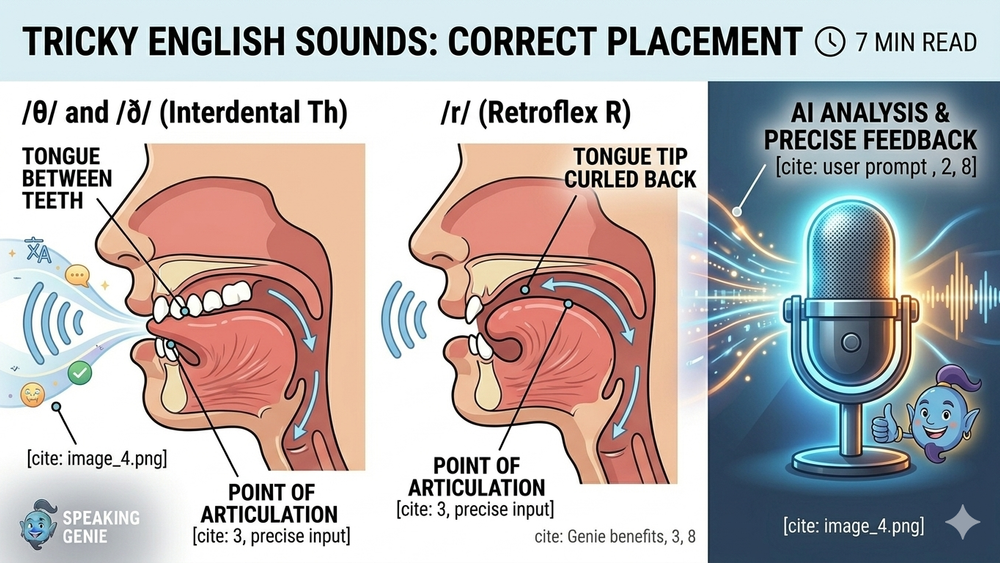
How to Fix It: This is a purely physical problem. You must train your tongue to do something unnatural. Lightly bite the very tip of your tongue between your top and bottom teeth. Now, blow air out.
- Unvoiced (Think, Thanks): Just blow air without vibrating your vocal cords.
- Voiced (This, That, The): Blow air while vibrating your vocal cords (make a humming sound in your throat).
Practice in front of a mirror to ensure your tongue is actually visible between your teeth!
2. The V vs. W Confusion
The Mistake: Speakers of German, Hindi, and several Slavic languages often mix up the "v" and "w" sounds, saying "wery" instead of "very," or "vater" instead of "water."
How to Fix It: These two sounds require completely different mouth shapes.
- For "V": Your top teeth must physically touch your bottom lip. Vibrate your lips slightly. (Think Very, Victor, Valve).
- For "W": Your teeth should not touch anything. Push your lips forward into a tight circle, like you are going to give a kiss or whistle. (Think Water, Wow, Window).
Get Instant Pronunciation Feedback
Not sure if you're saying it right? Let Speaking Genie's AI listen and show you exactly how to adjust your pronunciation.
Test Your Pronunciation Free3. The R vs. L Switch
The Mistake: Native speakers of Japanese, Korean, and some Chinese dialects frequently struggle to differentiate the English "R" and "L," often substituting one for the other (e.g., "play" sounds like "pray").
How to Fix It: Pay attention to the roof of your mouth.
- For "L": The tip of your tongue must firmly press against the bony ridge right behind your top front teeth. Keep it there while making the sound.
- For "R": The tip of your tongue pulls back and hovers in the middle of your mouth. It must not touch the roof of your mouth. The sides of your tongue should press against your upper back teeth.
4. Ignoring the "Schwa" (The Lazy Vowel)
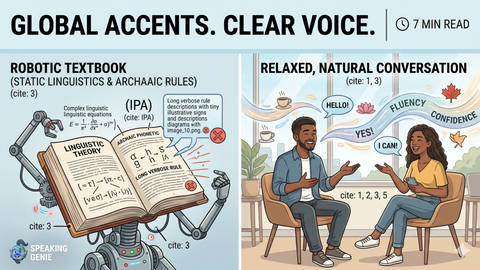
The Mistake: English is a stress-timed language. We do not pronounce every vowel clearly. Unstressed vowels are reduced to a lazy, relaxed sound called the Schwa (written as ə). It sounds like a short "uh." Learners often over-pronounce words exactly as they are spelled, which sounds robotic and unnatural.
How to Fix It: Stop reading words letter by letter. In the word "Doctor," it is not pronounced "Doc-TOR." The "or" is unstressed. It becomes a Schwa: "Doc-tuh." In "About," it isn't an "Ah" sound; it's "Uh-bout." Practicing the shadowing technique with native audio is the best way to naturally absorb the rhythm of the Schwa.
How AI Accelerates Pronunciation Correction
Reading about tongue placement is easy; executing it in real-time conversation is incredibly hard. This is where most learners get stuck. You need repetition and you need an objective listener.
This is why tools like Speaking Genie are revolutionary. You can practice saying tricky words 50 times in a row without a human teacher getting annoyed. The AI utilizes advanced speech recognition to analyze your phonemes. If you use a "W" instead of a "V", the AI instantly highlights the error, allowing you to adjust your mouth and try again.
This rapid feedback loop builds neuro-confidence and physical muscle memory, ensuring that the next time you speak to a native speaker, your message is heard loud and clear.
Fix Your Tricky Pronunciations
Stop guessing if you sound correct. Use Speaking Genie's AI to get pinpoint accuracy feedback on your vowels, consonants, and rhythm.
Start Your Pronunciation TrainingInstant phonetic feedback. Practice in private.