Speaking Genie Logo

Our Blog

How Long Does It Take to Speak English Fluently? (The Real Math)

Apr 19, 2026 路 how long to learn English, how many hours to fluent English, learn English fast, English fluency timeline

How Long Does It Take to Speak English Fluently? (The Real Math)

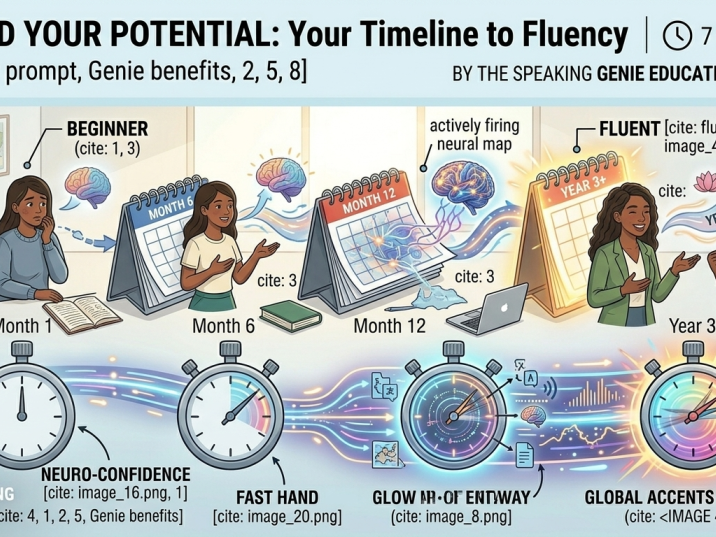
How Long Does It Take to Speak English Fluently? (The Real Math) /* Custom typography - scoped to avoid overriding CTAs */ .prose h2 { color: #1e3a8a; margin-top: 2rem; margin-bottom: 1rem; font-weight: 700; font-size: 1.875rem; } .prose h3 { color: #2563eb; margin-top: 1.5rem; margin-bottom: 0.75rem; font-weight: 600; font-size: 1.5rem; } .prose p { margin-bottom: 1.25rem; line-height: 1.75; color: #374151; } .prose ul, .prose ol { margin-bottom: 1.25rem; padding-left: 1.5rem; } .prose li { margin-bottom: 0.5rem; color: #374151; list-style-type: disc; } .prose strong { color: #111827; } .prose blockquote { border-left: 4px solid #3b82f6; padding-left: 1rem; font-style: italic; color: #4b5563; background-color: #eff6ff; padding: 1rem; border-radius: 0.25rem;} .prose a { color: #2563eb; text-decoration: underline; } .prose a:hover { color: #1d4ed8; } How Long Does It Take to Speak English Fluently? (The Real Math) By the Speaking Genie Educational Team | 8 min read Key Takeaways Fluency isn't measured in years; it is measured in hours of active practice. According to linguistic institutes, it takes roughly 600 to 750 hours of study to reach conversational fluency (B2 level). Watching English TV counts as passive time. To become fluent, you must log active speaking hours. You can drastically accelerate this timeline by using at-home micro-immersion and AI speaking tools. It is the most common question asked by every single language learner: "How long is this going to take?" If you search online, you will find wildly contradictory answers. Some language schools claim you will be fluent in 30 days. Others say it takes 5 years. The truth is, measuring language learning in "months" or "years" is completely inaccurate. If Learner A studies for 10 minutes a week, and Learner B studies for 2 hours a day, comparing their progress by "months" makes no sense. The only metric that matters is hours. Let's break down the real math behind fluency. The Official Fluency Timeline (The CEFR Scale) Linguists use the Common European Framework of Reference for Languages (CEFR) to measure proficiency. It ranges from A1 (Beginner) to C2 (Mastery). For most people, "fluency" means reaching the B2 level (Upper-Intermediate). At B2, you can converse smoothly, express opinions, and work in an English-speaking environment without straining the listener. According to data from Cambridge Assessment English and the U.S. Foreign Service Institute (FSI), reaching a B2 level in English typically requires around 600 to 750 cumulative hours of guided learning. 1 hour a week: 14 years. (This is why high school language classes often fail). 1 hour a day: About 2 years. 3 hours a day: About 6 to 8 months. The Trap: Passive vs. Active Hours Here is where most learners miscalculate their hours. Not all study hours are created equal. If you spend 200 hours watching Netflix with English subtitles, you have logged 200 hours of passive input. You will certainly improve your vocabulary, but you have logged zero hours of active output. This imbalance is exactly why so many people understand English perfectly but freeze when they try to speak. To achieve spoken fluency, at least 30% to 50% of your 600 hours must be spent actively speaking. Your vocal cords must vibrate. Your brain must construct sentences in real-time. You must build neuro-confidence. Start Logging Your Speaking Hours Don't just listen. Speak! Get unlimited conversational practice and hit your fluency goals faster with Speaking Genie. Start Your Free Speaking Session How to Accelerate the Timeline If 600 hours sounds intimidating, don't panic. You can radically compress this timeline by studying smarter, not harder. Here are the three best ways to speed up your journey to fluency: 1. Embrace "Micro-Immersion" You don't need to block out 3 hours every evening. Use "habit stacking." Spend 15 minutes talking out loud during your commute. Spend 10 minutes practicing phrasal verbs while making coffee. By integrating English into your daily at-home routines, you can easily log an hour of practice without changing your schedule. 2. Use the Shadowing Technique As covered in our guide to the Shadowing Technique, repeating native audio out loud builds physical "mouth muscle memory." This allows you to master pronunciation significantly faster than reading out of a textbook. 3. Get a 24/7 AI Language Coach The hardest part of logging active speaking hours used to be finding a native speaker to talk to. In 2026, you simply open an app. By using an AI conversational partner like Speaking Genie, you can practice high-speed, dynamic conversations anytime, anywhere. Because the AI forces you to respond in real-time, it stops you from translating in your head. An hour of intense AI conversation is worth three hours of passive classroom listening. Conclusion: It's a Marathon, Not a Sprint Fluency is not a destination you magically arrive at; it is a habit you build daily. Stop counting the months and start tracking your speaking hours. Stay consistent, prioritize active conversation, and you will find yourself speaking effortlessly before you know it. Accelerate Your Path to Fluency Every minute counts. Start logging your active speaking hours in a 100% judgment-free zone with Speaking Genie's AI tutor. Try Speaking Genie for Free Instant access. Unlimited speaking practice.

Why You Sound Like a Textbook (And How to Speak Naturally)

Apr 19, 2026 路 sound natural in English, textbook English vs spoken English, speak English naturally, conversational English fluency

Why You Sound Like a Textbook (And How to Speak Naturally)

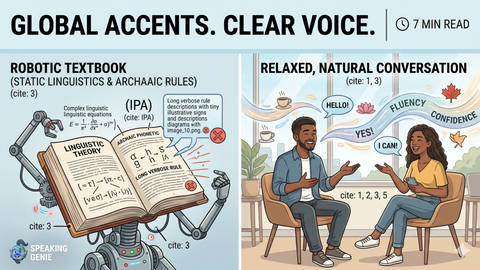
Why You Sound Like a Textbook (And How to Speak Naturally) /* Custom typography - scoped to avoid overriding CTAs */ .prose h2 { color: #1e3a8a; margin-top: 2rem; margin-bottom: 1rem; font-weight: 700; font-size: 1.875rem; } .prose h3 { color: #2563eb; margin-top: 1.5rem; margin-bottom: 0.75rem; font-weight: 600; font-size: 1.5rem; } .prose p { margin-bottom: 1.25rem; line-height: 1.75; color: #374151; } .prose ul, .prose ol { margin-bottom: 1.25rem; padding-left: 1.5rem; } .prose li { margin-bottom: 0.5rem; color: #374151; list-style-type: disc; } .prose strong { color: #111827; } .prose blockquote { border-left: 4px solid #3b82f6; padding-left: 1rem; font-style: italic; color: #4b5563; background-color: #eff6ff; padding: 1rem; border-radius: 0.25rem;} .prose a { color: #2563eb; text-decoration: underline; } .prose a:hover { color: #1d4ed8; } Why You Sound Like a Textbook (And How to Speak Naturally) By the Speaking Genie Educational Team | 7 min read Key Takeaways Grammatically perfect English often sounds unnatural and robotic in casual, real-world conversations. Native speakers rely heavily on contractions, connected speech, and phrasal verbs rather than formal vocabulary. To sound natural, you must unlearn some rigid rules taught in traditional language classes and focus on how native speakers actually converse. Practicing casual scenarios with an AI language partner helps you adopt natural speech patterns without triggering language anxiety. There is a strange phenomenon that happens to advanced English learners. You study for years, master complex grammar, and memorize thousands of words. But when you finally sit down at a caf茅 to talk with a native speaker, they look slightly confused. They understand you perfectly, but something feels off. You sound too formal. Too stiff. You sound like a walking grammar textbook. If your goal is to connect with people, sounding "perfect" is actually a barrier. Here is why you sound robotic, and how to transition from academic English to natural, conversational fluency. The Textbook Trap Traditional language schools are designed to pass written exams. They teach you to say: "Hello, how are you today? I am fine, thank you. I would like to purchase a coffee." While this is 100% grammatically correct, a native speaker in a caf茅 would actually say: "Hey, how's it going? I'm good, thanks. Can I get a coffee?" When you use academic English in a casual setting, it creates a subtle distance between you and the listener. It can make you feel like an outsider and, ironically, often triggers the speaking freeze because your brain is working too hard to construct formal, rigid sentences. 3 Ways to Speak English More Naturally 1. Master Contractions and Connected Speech Native speakers are lazy. They rarely pronounce every single word clearly. Instead, they mash words together. This is called connected speech. Instead of saying "Do you want to go out?", a native speaker says "D'ya wanna go out?" Instead of "I am going to," they say "I'm gonna." You don't need to use heavy slang, but you must use basic contractions (I'm, can't, won't, haven't). If you say "I do not want to go," it sounds like you are angry or giving a dramatic speech. 2. Swap Formal Verbs for Phrasal Verbs Textbooks love Latin-based, formal verbs. Native speakers love phrasal verbs. Instead of saying "I must depart," say "I need to take off." Instead of "Please continue," say "Please go on." Instead of "I cannot tolerate this," say "I can't put up with this." Learning the top 50 most common phrasal verbs will do more for your conversational fluency than memorizing a dictionary of advanced academic vocabulary. Ditch the Textbook Learn how people actually talk. Practice casual, natural English conversations with Speaking Genie's interactive AI. Start a Casual Chat Now 3. Embrace Natural Fillers Language learners are taught that saying "Uhm" is bad. While you shouldn't overuse it, native speakers use filler words constantly to buy time to think. The trick is using natural fillers instead of freezing in total silence. Start using phrases like: "Well...", "You know...", "I mean...", "To be honest...". These short phrases signal to the listener that you are still thinking and haven't finished your turn to speak, giving you the time you need to stop translating in your head. How to Unlearn "Robot" English To start sounding natural, you need a safe place to practice making mistakes. If you try to use a new phrasal verb with a native speaker and use it incorrectly, it can be embarrassing. This is where an AI conversational partner like Speaking Genie becomes your greatest tool. You can set the AI to "Casual Mode" and role-play everyday scenarios鈥攍ike chatting with a neighbor, making small talk at a party, or asking a coworker about their weekend. Because the AI uses natural, colloquial English, you will naturally start to shadow its rhythm and vocabulary. You build the neuro-confidence required to step away from the textbook and step into real life. Speak English Like a Human, Not a Robot Master connected speech, phrasal verbs, and natural conversational flow. Practice unscripted, real-world English with Speaking Genie today. Try Speaking Genie for Free Instant access. Learn the English they don't teach in textbooks.

Common English Pronunciation Mistakes and How to Fix Them

Apr 19, 2026 路 common English pronunciation mistakes, fix English pronunciation, tricky English words, improve English accent

Common English Pronunciation Mistakes and How to Fix Them

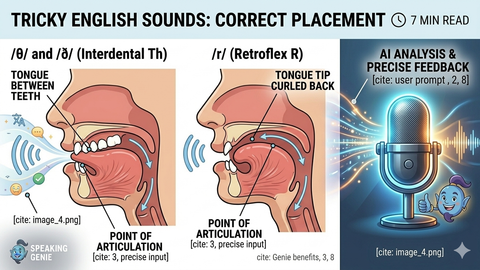
Common English Pronunciation Mistakes and How to Fix Them /* Custom typography - scoped to avoid overriding CTAs */ .prose h2 { color: #1e3a8a; margin-top: 2rem; margin-bottom: 1rem; font-weight: 700; font-size: 1.875rem; } .prose h3 { color: #2563eb; margin-top: 1.5rem; margin-bottom: 0.75rem; font-weight: 600; font-size: 1.5rem; } .prose p { margin-bottom: 1.25rem; line-height: 1.75; color: #374151; } .prose ul, .prose ol { margin-bottom: 1.25rem; padding-left: 1.5rem; } .prose li { margin-bottom: 0.5rem; color: #374151; list-style-type: disc; } .prose strong { color: #111827; } .prose blockquote { border-left: 4px solid #3b82f6; padding-left: 1rem; font-style: italic; color: #4b5563; background-color: #eff6ff; padding: 1rem; border-radius: 0.25rem;} .prose a { color: #2563eb; text-decoration: underline; } .prose a:hover { color: #1d4ed8; } Common English Pronunciation Mistakes and How to Fix Them By the Speaking Genie Educational Team | 8 min read Key Takeaways Pronunciation mistakes usually happen because the specific English sound does not exist in the learner's native language. The most common errors involve the "th" sound, the V vs. W distinction, and the elusive "Schwa" vowel. Fixing these errors requires physical "mouth muscle memory" training, not just mental memorization. Using real-time AI pronunciation feedback is the fastest way to isolate and correct these specific phonemes. English pronunciation is notoriously chaotic. Words that look the same sound completely different (think tough, through, and though). For non-native speakers, this lack of phonetic consistency can be incredibly frustrating and often leads to the speaking freeze. However, while English has many exceptions, the mistakes learners make are highly predictable. Depending on your native language, your brain is wired to substitute unfamiliar English sounds with familiar ones from your mother tongue. Let鈥檚 break down the four most common English pronunciation mistakes and give you practical, physical exercises to fix them. 1. The Dreaded "TH" Sound (胃 and 冒) The Mistake: The "th" sound does not exist in most of the world's languages. As a result, learners often substitute it with a "t/d", an "s/z", or an "f/v". For example, saying "sink" instead of "think," or "dis" instead of "this." How to Fix It: This is a purely physical problem. You must train your tongue to do something unnatural. Lightly bite the very tip of your tongue between your top and bottom teeth. Now, blow air out. Unvoiced (Think, Thanks): Just blow air without vibrating your vocal cords. Voiced (This, That, The): Blow air while vibrating your vocal cords (make a humming sound in your throat). Practice in front of a mirror to ensure your tongue is actually visible between your teeth! 2. The V vs. W Confusion The Mistake: Speakers of German, Hindi, and several Slavic languages often mix up the "v" and "w" sounds, saying "wery" instead of "very," or "vater" instead of "water." How to Fix It: These two sounds require completely different mouth shapes. For "V": Your top teeth must physically touch your bottom lip. Vibrate your lips slightly. (Think Very, Victor, Valve). For "W": Your teeth should not touch anything. Push your lips forward into a tight circle, like you are going to give a kiss or whistle. (Think Water, Wow, Window). Get Instant Pronunciation Feedback Not sure if you're saying it right? Let Speaking Genie's AI listen and show you exactly how to adjust your pronunciation. Test Your Pronunciation Free 3. The R vs. L Switch The Mistake: Native speakers of Japanese, Korean, and some Chinese dialects frequently struggle to differentiate the English "R" and "L," often substituting one for the other (e.g., "play" sounds like "pray"). How to Fix It: Pay attention to the roof of your mouth. For "L": The tip of your tongue must firmly press against the bony ridge right behind your top front teeth. Keep it there while making the sound. For "R": The tip of your tongue pulls back and hovers in the middle of your mouth. It must not touch the roof of your mouth. The sides of your tongue should press against your upper back teeth. 4. Ignoring the "Schwa" (The Lazy Vowel) The Mistake: English is a stress-timed language. We do not pronounce every vowel clearly. Unstressed vowels are reduced to a lazy, relaxed sound called the Schwa (written as 蓹). It sounds like a short "uh." Learners often over-pronounce words exactly as they are spelled, which sounds robotic and unnatural. How to Fix It: Stop reading words letter by letter. In the word "Doctor," it is not pronounced "Doc-TOR." The "or" is unstressed. It becomes a Schwa: "Doc-tuh." In "About," it isn't an "Ah" sound; it's "Uh-bout." Practicing the shadowing technique with native audio is the best way to naturally absorb the rhythm of the Schwa. How AI Accelerates Pronunciation Correction Reading about tongue placement is easy; executing it in real-time conversation is incredibly hard. This is where most learners get stuck. You need repetition and you need an objective listener. This is why tools like Speaking Genie are revolutionary. You can practice saying tricky words 50 times in a row without a human teacher getting annoyed. The AI utilizes advanced speech recognition to analyze your phonemes. If you use a "W" instead of a "V", the AI instantly highlights the error, allowing you to adjust your mouth and try again. This rapid feedback loop builds neuro-confidence and physical muscle memory, ensuring that the next time you speak to a native speaker, your message is heard loud and clear. Fix Your Tricky Pronunciations Stop guessing if you sound correct. Use Speaking Genie's AI to get pinpoint accuracy feedback on your vowels, consonants, and rhythm. Start Your Pronunciation Training Instant phonetic feedback. Practice in private.

Top 10 Daily Routines for Language Immersion Without Traveling

Apr 19, 2026 路 language immersion at home, learn English at home, language learning routine, daily English practice

Top 10 Daily Routines for Language Immersion Without Traveling

Top 10 Daily Routines for Language Immersion Without Traveling /* Custom typography - scoped to avoid overriding CTAs */ .prose h2 { color: #1e3a8a; margin-top: 2rem; margin-bottom: 1rem; font-weight: 700; font-size: 1.875rem; } .prose h3 { color: #2563eb; margin-top: 1.5rem; margin-bottom: 0.75rem; font-weight: 600; font-size: 1.5rem; } .prose p { margin-bottom: 1.25rem; line-height: 1.75; color: #374151; } .prose ul, .prose ol { margin-bottom: 1.25rem; padding-left: 1.5rem; } .prose li { margin-bottom: 0.5rem; color: #374151; list-style-type: disc; } .prose strong { color: #111827; } .prose blockquote { border-left: 4px solid #3b82f6; padding-left: 1rem; font-style: italic; color: #4b5563; background-color: #eff6ff; padding: 1rem; border-radius: 0.25rem;} .prose a { color: #2563eb; text-decoration: underline; } .prose a:hover { color: #1d4ed8; } Top 10 Daily Routines for Language Immersion Without Traveling By the Speaking Genie Educational Team | 9 min read Key Takeaways Language immersion is a mindset, not a location. You can build a 100% English environment inside your own house. The secret to rapid fluency is "habit stacking"鈥攁ttaching short language practice to things you already do every day. To bridge the gap between listening and speaking, you must include active vocal routines. Using AI tools allows you to simulate real-world conversations, eliminating the need to find native speakers in your city. There is a dangerous myth in language learning: "I can't become fluent because I don't live in an English-speaking country." Before the internet, this might have been true. But today, the environment you live in is entirely digital and highly customizable. If you want to master English, you don't need to pack your bags and move to London. You just need to change your daily habits. Creating a "micro-immersion" environment at home requires zero extra free time. It simply requires replacing your native language with your target language during your normal daily activities. Here are the top 10 daily routines to immerse yourself in English without ever leaving your house. Morning Routines (Setting the Tone) 1. The Device Language Switch This is step one of home immersion. Change the language of your smartphone, laptop, and social media accounts to English. You look at your phone hundreds of times a day. By forcing your brain to navigate menus, read notifications, and check the weather in English, you immediately normalize the language in your daily life. 2. The "Shower Shadowing" Session Turn your morning shower into a pronunciation lab. Play an English podcast on your phone speaker and practice the shadowing technique out loud. Repeat what the speaker says, matching their intonation. Because you are alone, there is zero language anxiety. It is the perfect vocal warm-up for the day. 3. AI Conversation with Your Morning Coffee Instead of mindlessly scrolling through Instagram while drinking your coffee, spend 10 minutes talking to an AI language partner. With Speaking Genie, you can launch a quick, casual chat about your plans for the day. This builds your neuro-confidence and forces you to think in English before you even leave for work. Start Your Day with Real Conversation Make English speaking a daily habit. Practice real-world scenarios over your morning coffee with Speaking Genie's AI tutor. Start Your Free Morning Practice Afternoon Routines (Maintaining Momentum) 4. The "Crazy Person" Narration Commute If you drive to work or walk to the store alone, talk to yourself out loud in English. Narrate what you see: "That car is driving too fast. I need to remember to buy milk." It feels silly at first, but this internal monologue training is the absolute fastest way to stop translating in your head. 5. English-Only News Feeds Stop reading the news in your native language. Subscribe to English newsletters or download news apps like BBC or CNN. When you read about global events in English, you acquire high-level vocabulary in a natural, engaging context. 6. The "Search Engine" Rule Make a hard rule for yourself: Whatever you need to Google, Google it in English. Whether you are looking for a pasta recipe, fixing a computer bug, or checking movie reviews, forcing yourself to search and read the results in English drastically improves your reading comprehension. 7. Workout to Target Language Audio If you go to the gym or run, swap out your normal music for an English audiobook or a conversational English podcast. Your brain is highly receptive when your heart rate is elevated, making this an excellent time for passive listening immersion. Evening Routines (Active Entertainment) 8. Netflix with Intent Watching Netflix can be an incredible immersion tool鈥攊f done correctly. First, never use subtitles in your native language (use English subtitles or none at all). Second, pause the show every 15 minutes and summarize out loud what just happened. This turns passive entertainment into active speaking practice. 9. The 5-Minute Gratitude Journal Before bed, write down three things you are grateful for or three things you did that day鈥攊n English. Journaling allows you to practice sentence structure and vocabulary retrieval without the pressure of a real-time conversation. 10. The Bedtime AI De-brief End your day the same way you started it: with a micro-immersion session. Log into Speaking Genie for 5 minutes. Tell the AI tutor about your day, what went well, and what you learned. This final vocalization helps consolidate your English pathways in your brain right before sleep. Conclusion Fluency is not the result of a magical trip abroad; it is the result of thousands of small, daily habits. By implementing these 10 routines, you will completely submerge your brain in English, overcoming the speaking freeze and building unstoppable confidence鈥攁ll from the comfort of your home. Your At-Home Immersion Partner You don't need a plane ticket to speak English fluently. Build your daily speaking habit with Speaking Genie's 24/7 AI language coach. Try Speaking Genie Today No credit card required. Practice anytime, anywhere.

The Shadowing Technique: The Secret to Sounding Like a Native Speaker

Apr 19, 2026 路 language shadowing technique, how to do speech shadowing, improve pronunciation, sound like a native speaker

The Shadowing Technique: The Secret to Sounding Like a Native Speaker

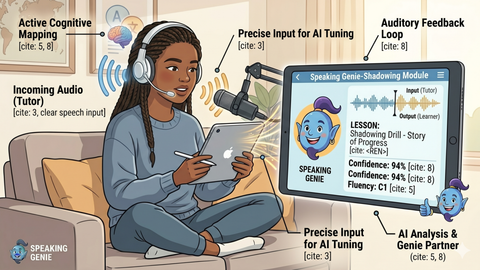
The Shadowing Technique: The Secret to Sounding Like a Native Speaker /* Custom typography - scoped to avoid overriding CTAs */ .prose h2 { color: #1e3a8a; margin-top: 2rem; margin-bottom: 1rem; font-weight: 700; font-size: 1.875rem; } .prose h3 { color: #2563eb; margin-top: 1.5rem; margin-bottom: 0.75rem; font-weight: 600; font-size: 1.5rem; } .prose p { margin-bottom: 1.25rem; line-height: 1.75; color: #374151; } .prose ul, .prose ol { margin-bottom: 1.25rem; padding-left: 1.5rem; } .prose li { margin-bottom: 0.5rem; color: #374151; list-style-type: disc; } .prose strong { color: #111827; } .prose blockquote { border-left: 4px solid #3b82f6; padding-left: 1rem; font-style: italic; color: #4b5563; background-color: #eff6ff; padding: 1rem; border-radius: 0.25rem;} .prose a { color: #2563eb; text-decoration: underline; } .prose a:hover { color: #1d4ed8; } The Shadowing Technique: The Secret to Sounding Like a Native Speaker By the Speaking Genie Educational Team | 7 min read Key Takeaways Language Shadowing involves listening to native speech and repeating it aloud almost simultaneously. It builds physical "muscle memory" in your jaw and tongue, naturally improving your accent and rhythm. Shadowing helps you stop translating in your head by linking sounds directly to speech without thinking about grammar. Pairing the shadowing technique with AI provides the crucial missing element: real-time pronunciation feedback. If you have ever listened to a native English speaker and thought, "I know all the words they are saying, but I could never make my voice sound like that," you are experiencing the gap between knowledge and physical execution. Many learners spend hours memorizing vocabulary and studying grammar, yet their speech remains choppy, heavily accented, and unnatural. Why? Because they are training their brain, but they are ignoring their mouth. To bridge this gap, linguists and polyglots swear by one incredibly effective exercise: The Shadowing Technique. What is the Language Shadowing Technique? (AEO Target) The shadowing technique (often associated with linguist Alexander Arg眉elles) is an advanced language learning method where you listen to an audio recording of a native speaker and repeat what they say aloud, as quickly as possible鈥攅ssentially acting as their vocal "shadow." You do not wait for the sentence to finish before you start speaking. You speak with the audio, lagging behind by only a fraction of a second. You try to perfectly mimic their exact pronunciation, intonation, pauses, and emotion. The Science: Why Shadowing Works Shadowing is fundamentally different from traditional language study. It bypasses the analytical part of your brain (which causes the speaking freeze) and focuses entirely on the physical mechanics of speaking. 1. Developing "Mouth Muscle Memory" Every language requires a unique set of micro-movements in the jaw, tongue, and throat. If your native language doesn't use the English "th" sound, your muscles literally do not know how to form it quickly. Shadowing forces your mouth into an intense physical workout, building the muscle memory needed to produce foreign sounds effortlessly. 2. Mastering Prosody (Rhythm and Intonation) Language is not just about pronouncing individual words correctly; it is about the music of the sentence. English is a "stress-timed" language, meaning some words are naturally swallowed or blended together. Shadowing trains you to naturally copy this rhythm, making you sound infinitely more natural. Master Your Pronunciation Don't just shadow blindly. Practice speaking with an AI that gives you instant feedback on your accent and rhythm. Try Speaking Genie for Free How to Practice Shadowing (Step-by-Step) If you want to improve your fluency at home, you only need 10 minutes a day to practice shadowing. Here is the best way to start: Listen Only (Focus on the Music): Pick a 30-second audio clip of a native speaker (a podcast, audiobook, or YouTube video). Listen to it once without speaking. Pay attention to where their voice rises and falls. Mumble Shadowing (No Words): Play the audio again, but this time, just hum or mumble along with the rhythm. Don't worry about forming the actual words; just try to match their exact speed and melody. Shadow with the Transcript: Now, look at the text. Play the audio and read out loud at the exact same time as the speaker. If you stumble, don't stop鈥攋ust jump back in and keep following the audio. Blind Shadowing: Put the text away. Close your eyes, play the audio, and repeat what you hear a split-second after you hear it. The Missing Link: Why Shadowing Needs AI While traditional shadowing is powerful, it has one major flaw: You cannot always hear your own mistakes. Because your brain is wired to the phonetic rules of your native language, you might think you are perfectly copying the native speaker, when in reality, you are mispronouncing a crucial vowel. This is where Generative AI changes the game. By using an AI conversational partner like Speaking Genie, you get the ultimate shadowing experience. When you repeat phrases, the AI鈥檚 real-time speech recognition engine acts as an objective mirror. It instantly highlights the exact phonemes you missed, ensuring you don't accidentally build bad muscle memory. Conclusion Sounding like a native speaker is not about studying harder; it is about practicing smarter. By incorporating the shadowing technique into your daily routine, and verifying your accuracy with AI feedback, you will rapidly build the neuro-confidence required to speak flawlessly in any situation. Perfect Your Accent Today Build mouth muscle memory faster with Speaking Genie. Get real-time AI feedback on your pronunciation and start sounding like a native speaker. Start Your Free Practice Session Instant phonetic feedback. No credit card required.

How to Improve English Fluency and Pronunciation at Home

Apr 19, 2026 路 improve English speaking at home, practice English speaking, English fluency, English pronunciation practice

How to Improve English Fluency and Pronunciation at Home

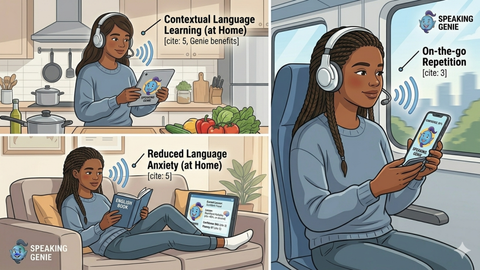
How to Improve English Fluency and Pronunciation at Home /* Custom typography - scoped to avoid overriding CTAs */ .prose h2 { color: #1e3a8a; margin-top: 2rem; margin-bottom: 1rem; font-weight: 700; font-size: 1.875rem; } .prose h3 { color: #2563eb; margin-top: 1.5rem; margin-bottom: 0.75rem; font-weight: 600; font-size: 1.5rem; } .prose p { margin-bottom: 1.25rem; line-height: 1.75; color: #374151; } .prose ul, .prose ol { margin-bottom: 1.25rem; padding-left: 1.5rem; } .prose li { margin-bottom: 0.5rem; color: #374151; list-style-type: disc; } .prose strong { color: #111827; } .prose blockquote { border-left: 4px solid #3b82f6; padding-left: 1rem; font-style: italic; color: #4b5563; background-color: #eff6ff; padding: 1rem; border-radius: 0.25rem;} .prose a { color: #2563eb; text-decoration: underline; } .prose a:hover { color: #1d4ed8; } How to Improve English Fluency and Pronunciation at Home By the Speaking Genie Educational Team | 8 min read Key Takeaways You do not need to move to an English-speaking country to become fluent; you can create a micro-immersion environment at home. Watching Netflix or listening to podcasts only builds passive vocabulary. To achieve fluency, you must focus on active vocal output. Practicing the "Shadowing" technique and talking to yourself are the fastest ways to build pronunciation muscle memory. Using a 24/7 AI conversational app allows you to get instant feedback on your pronunciation without leaving your living room. A common misconception in language learning is that fluency requires a plane ticket. People assume that unless you move to London, New York, or Sydney, you will never truly master English pronunciation or overcome the dreaded speaking freeze. In 2026, this is entirely false. With the right strategies and modern technology, you can engineer an immersive, highly effective English learning environment from the comfort of your own home. Whether you are an absolute beginner or an intermediate learner stuck on a plateau, here is your comprehensive guide to improving English fluency and pronunciation without stepping out your front door. The Golden Rule: Output > Input Before we look at the exercises, we need to fix a major mistake most self-taught learners make: consuming too much and producing too little. Watching English YouTube videos, reading articles, and listening to music are examples of passive input. They are great for comprehension, but they will not help you speak. Fluency is a physical skill, much like playing the piano. You cannot learn to play the piano just by listening to Mozart. You have to move your fingers. To improve your spoken English at home, 80% of your study time must be dedicated to active output鈥攎eaning your vocal cords must be vibrating and your mouth must be moving. 4 Daily Exercises for At-Home Fluency 1. The Shadowing Technique Shadowing is the secret weapon of polyglots. Find an audio clip of a native speaker (a podcast snippet or an audiobook works perfectly). Listen to a sentence, and then immediately repeat it out loud, trying to perfectly mimic the speaker鈥檚 rhythm, intonation, and accent. This builds physical muscle memory in your mouth. (We dive deeper into this in our full guide on The Shadowing Technique). 2. Narrate Your Life Since you are at home, you have the luxury of privacy. Use it! As you go about your day, describe what you are doing out loud in English. "I am boiling water for pasta. I need to take the dog for a walk." This forces your brain to stop translating and start associating English words directly with your daily actions. Practice Speaking Without Leaving Home Turn your living room into an English immersion zone. Have real-time conversations with Speaking Genie's AI tutor today. Start Your Free At-Home Practice 3. Read Out Loud (Hyper-Exaggerated) Reading silently only trains your eyes. Grab an English article or a book and read it out loud. But here is the trick: over-exaggerate your pronunciation. Open your mouth wider than normal and hit every consonant hard. This acts as a warm-up for your jaw and tongue, making normal conversation feel much easier and smoother. 4. Have Daily AI Conversations The biggest challenge of at-home learning used to be the lack of a conversation partner to correct your mistakes. Today, you can access 24/7 immersive practice through Generative AI. By using an app like Speaking Genie, you can engage in dynamic, unscripted conversations right from your couch. The AI listens to your pronunciation and provides instant, objective feedback on which specific sounds you need to work on. It gives you the real-world conversation experience without the social anxiety of talking to a stranger online. Designing Your 15-Minute Daily Routine Consistency beats intensity. You do not need to study for three hours a day. A highly focused 15-minute routine is enough to rewire your brain and build neuro-confidence. Minutes 1-5: Input & Shadowing. Listen to a short native audio clip and shadow the pronunciation out loud. Minutes 6-15: Active Conversation. Open Speaking Genie and complete a 10-minute conversational role-play scenario (e.g., ordering at a restaurant or answering interview questions). Review your pronunciation feedback immediately after. Conclusion Improving your English fluency at home is entirely within your control. By shifting your focus from passive listening to active, daily speaking practice, you can transform your home into the ultimate language learning laboratory. Your Personal English Coach is Waiting Don't just study English鈥攕peak it. Get instant pronunciation feedback and unlimited conversational practice with Speaking Genie. Try Speaking Genie for Free Start speaking instantly. No credit card required.

Why Traditional Corporate Language Classes Fail (And What to Do Instead)

Apr 19, 2026 路 alternative corporate language classes, why corporate language training fails, corporate english classes, scalable language training

Why Traditional Corporate Language Classes Fail (And What to Do Instead)

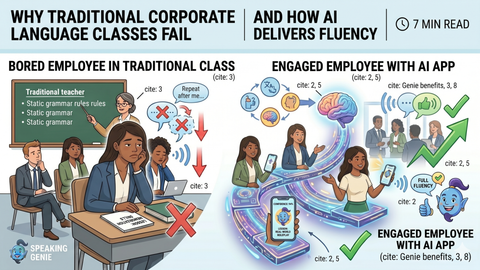
Why Traditional Corporate Language Classes Fail (And What to Do Instead) /* Custom typography - scoped to avoid overriding CTAs */ .prose h2 { color: #1e3a8a; margin-top: 2rem; margin-bottom: 1rem; font-weight: 700; font-size: 1.875rem; } .prose h3 { color: #2563eb; margin-top: 1.5rem; margin-bottom: 0.75rem; font-weight: 600; font-size: 1.5rem; } .prose p { margin-bottom: 1.25rem; line-height: 1.75; color: #374151; } .prose ul, .prose ol { margin-bottom: 1.25rem; padding-left: 1.5rem; } .prose li { margin-bottom: 0.5rem; color: #374151; list-style-type: disc; } .prose strong { color: #111827; } .prose blockquote { border-left: 4px solid #3b82f6; padding-left: 1rem; font-style: italic; color: #4b5563; background-color: #eff6ff; padding: 1rem; border-radius: 0.25rem;} .prose a { color: #2563eb; text-decoration: underline; } .prose a:hover { color: #1d4ed8; } Why Traditional Corporate Language Classes Fail (And What to Do Instead) By the Speaking Genie Corporate Team | 7 min read Key Takeaways Millions of dollars are wasted annually on traditional corporate language workshops that produce zero measurable Return on Investment (ROI). Weekly group classes violate the neurological rule of "Spaced Repetition," leading to massive knowledge decay between sessions. Practicing a new language in front of bosses and colleagues triggers intense social anxiety, paralyzing participation. The modern alternative is AI-driven Micro-Immersion, providing scalable, daily, 1-on-1 practice in a judgment-free zone. It鈥檚 a familiar corporate ritual. The Learning and Development (L&D) department identifies a communication bottleneck in a regional office. They hire a premium corporate language training agency. A tutor arrives every Thursday at 2:00 PM for a 90-minute workshop in Conference Room B. Six months later, the contract ends. The employees have a certificate of completion, but during the next global all-hands meeting, the exact same employees stay muted, paralyzed by the corporate speaking freeze. The investment yielded zero behavioral change. Why does this happen so frequently? It鈥檚 not because the employees are unmotivated, and it鈥檚 not because the tutor was incompetent. It is because the structural model of the "weekly corporate language class" is fundamentally broken. Here are the three reasons why it fails, and how forward-thinking companies are fixing it. Reason 1: The Forgetting Curve In the late 19th century, psychologist Hermann Ebbinghaus discovered the "Forgetting Curve"鈥攖he exponential rate at which humans forget new information if it isn't repeatedly reviewed. According to his research, learners forget up to 75% of new information within just a few days if they don't apply it. A weekly corporate language class is the ultimate victim of the Forgetting Curve. An employee learns a set of business negotiation vocabulary on Thursday. They don't practice it Friday through Wednesday. By the time the next Thursday rolls around, the tutor has to spend half the class reviewing last week's material. There is no momentum, only stagnation. Reason 2: The High "Affective Filter" As we've discussed heavily in our guides on Foreign Language Anxiety, language acquisition shuts down when a learner feels stressed or judged. This psychological barrier is called the Affective Filter. Now, imagine trying to practice your broken English grammar while sitting across the table from the Director of Sales who decides your next promotion. The corporate environment is inherently high-stakes. Employees are terrified of looking incompetent in front of their peers or superiors. As a result, they participate the bare minimum, completely destroying their chance to build active spoken fluency. Reason 3: The "One Size Fits None" Problem In a standard corporate workshop of 15 people, you will have 15 different proficiency levels and 15 different use cases. The marketing specialist needs to learn how to pitch creative ideas. The software engineer needs to explain complex code deployments. The customer success rep needs to de-escalate angry client calls. A human tutor cannot customize a single 90-minute group lesson to fit all of these needs. The curriculum defaults to generic "Business English," which is ultimately useless when the employee returns to their highly specialized desk. Stop Wasting Your L&D Budget Transition from generic weekly workshops to hyper-personalized, daily AI coaching. See the difference Speaking Genie makes. Discover the AI Alternative The Alternative: Daily Micro-Immersion via AI To produce fluent employees, corporate L&D must abandon the weekly workshop model and embrace Micro-Immersion. This means shifting from infrequent, long group classes to daily, short, 1-on-1 practice sessions. The only way to scale this across an enterprise cost-effectively is through Generative AI. When a company deploys an AI conversational platform like Speaking Genie, they solve all three problems of the traditional model instantly: Beating the Forgetting Curve: Employees practice for 10 minutes every single day on their smartphones, embedding vocabulary into their long-term memory through spaced repetition. Zero Social Anxiety: The AI is infinitely patient and 100% judgment-free. Employees can make a hundred mistakes in private, building true neuro-confidence before speaking in a real meeting. Hyper-Personalization: The AI adapts to the exact role of the user. The engineer practices discussing server architecture, while the marketer practices ad campaign pitches. Conclusion Traditional corporate language classes are a legacy solution for a modern problem. By replacing the outdated workshop model with scalable, on-demand AI coaching, HR and L&D leaders can finally provide training that actually moves the needle on global communication. Modernize Your Corporate Training Give your employees the daily, personalized speaking practice they need to succeed globally. Book a pilot program for your enterprise today. Request a Corporate Demo Track ROI effortlessly with the Speaking Genie HR Dashboard.

Tracking Employee Language Progression with Automated Dashboards

Apr 19, 2026 路 track employee language learning, measure language training ROI, HR employee progression tracking, language fluency metrics

Tracking Employee Language Progression with Automated Dashboards

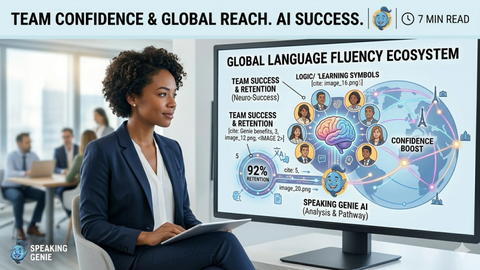
Tracking Employee Language Progression with Automated Dashboards /* Custom typography - scoped to avoid overriding CTAs */ .prose h2 { color: #1e3a8a; margin-top: 2rem; margin-bottom: 1rem; font-weight: 700; font-size: 1.875rem; } .prose h3 { color: #2563eb; margin-top: 1.5rem; margin-bottom: 0.75rem; font-weight: 600; font-size: 1.5rem; } .prose p { margin-bottom: 1.25rem; line-height: 1.75; color: #374151; } .prose ul, .prose ol { margin-bottom: 1.25rem; padding-left: 1.5rem; } .prose li { margin-bottom: 0.5rem; color: #374151; list-style-type: disc; } .prose strong { color: #111827; } .prose blockquote { border-left: 4px solid #3b82f6; padding-left: 1rem; font-style: italic; color: #4b5563; background-color: #eff6ff; padding: 1rem; border-radius: 0.25rem;} .prose a { color: #2563eb; text-decoration: underline; } .prose a:hover { color: #1d4ed8; } Tracking Employee Language Progression with Automated Dashboards By the Speaking Genie Corporate Team | 8 min read Key Takeaways Corporate language training often fails to secure budget renewal because HR cannot prove a measurable Return on Investment (ROI). Traditional completion certificates do not prove that an employee can actually speak the language in a real-world scenario. Automated HR Dashboards provide real-time visibility into employee engagement, speaking hours, and actual fluency progression. Data-driven tracking ensures accountability, allowing managers to identify top performers and intervene when employees fall behind. Imagine your company just invested $50,000 in a new language training program for its global sales team. Six months later, the CFO asks you a simple question: "Did it work?" If your only answer is, "Well, 80% of the team finished the online modules," you are in trouble. Completing a module is a metric of activity, not a metric of capability. The CFO doesn't care if they finished the workbook; they care if the sales team can now negotiate a contract in English without freezing. For HR and Learning & Development (L&D) managers, visibility is everything. Here is why traditional tracking methods are failing, and how automated dashboards are providing the hard data needed to prove the success of your language programs. The Flaw of "Completion Certificates" Historically, corporate training has relied on the "completion certificate" model. An employee watches a series of videos, passes a multiple-choice grammar quiz, and receives a digital certificate. This model is fundamentally flawed for language learning because of the gap between passive knowledge and active fluency. A grammar test proves an employee understands the rules of the language, but it does absolutely nothing to measure their ability to speak confidently in a high-stress virtual meeting. To measure real progression, you must measure spoken output. But how do you assess the speaking ability of 5,000 employees simultaneously? Enter the Automated HR Dashboard When you deploy an AI-driven conversational platform like Speaking Genie, you aren't just giving your employees a tool; you are giving your HR department a real-time data center. Because the employees are practicing their speaking skills with an AI, the platform is able to track, analyze, and quantify every single interaction. This data is aggregated into an intuitive HR dashboard, allowing you to monitor progression across the entire enterprise. Stop Guessing. Start Measuring. Get complete visibility into your workforce's fluency progress. Track active speaking hours and pronunciation scores with Speaking Genie's HR Dashboard. Book a Dashboard Demo 3 Crucial Metrics You Should Be Tracking To prove ROI, your dashboard needs to provide actionable metrics that correlate to business success. Here are the three metrics that matter most: 1. Active Speaking Hours (Engagement) You cannot improve what you do not practice. The dashboard tracks the exact amount of time an employee spends actively vocalizing in the target language. If the engineering team in Berlin averages 4 hours of speaking practice a month, but the sales team in Tokyo only averages 30 minutes, HR immediately knows where to direct their motivational efforts. 2. Phonemic Clarity Scores A heavy accent only becomes a problem when it creates a communication bottleneck. The dashboard utilizes real-time speech recognition to assign an objective intelligibility score. You can physically watch a team's clarity score rise from 65% to 85% over a quarter, proving that cross-border miscommunications are actively decreasing. 3. Business Vocabulary Utilization It's great if an employee can talk about the weather, but can they talk about Q3 deliverables? Advanced dashboards track the specific vocabulary chunks being used during AI role-play sessions, ensuring that employees are mastering the exact terminology required for their specific department. Accountability and Talent Identification Data isn't just for proving ROI to the CFO; it is a powerful tool for talent management. When training is unmonitored, engagement drops. An automated dashboard creates healthy accountability. Managers can set clear expectations (e.g., "We expect 2 hours of AI conversational practice per week") and easily verify compliance without micromanaging. Furthermore, it allows HR to identify emerging global talent. If you see a junior manager in a regional office consistently logging high hours and rapidly improving their English fluency, you have just identified an employee with the drive, discipline, and communication skills necessary for global leadership. Conclusion Language training should never be a black box. By utilizing AI to automate the tracking of spoken fluency, HR departments can finally transition from issuing meaningless completion certificates to delivering undeniable, data-driven business results. Prove the Value of Your L&D Budget Equip your HR team with the data they need to succeed. Discover how Speaking Genie's automated tracking transforms corporate language training. Explore Our Enterprise Analytics Seamlessly integrate fluency data with your existing HRIS.

Scaling Fluent Workforces: The Role of AI in Corporate L&D

Apr 19, 2026 路 AI in corporate language training, scalable language training, corporate L&D language programs, AI language coach for business

Scaling Fluent Workforces: The Role of AI in Corporate L&D

Scaling Fluent Workforces: The Role of AI in Corporate L&D /* Custom typography - scoped to avoid overriding CTAs */ .prose h2 { color: #1e3a8a; margin-top: 2rem; margin-bottom: 1rem; font-weight: 700; font-size: 1.875rem; } .prose h3 { color: #2563eb; margin-top: 1.5rem; margin-bottom: 0.75rem; font-weight: 600; font-size: 1.5rem; } .prose p { margin-bottom: 1.25rem; line-height: 1.75; color: #374151; } .prose ul, .prose ol { margin-bottom: 1.25rem; padding-left: 1.5rem; } .prose li { margin-bottom: 0.5rem; color: #374151; list-style-type: disc; } .prose strong { color: #111827; } .prose blockquote { border-left: 4px solid #3b82f6; padding-left: 1rem; font-style: italic; color: #4b5563; background-color: #eff6ff; padding: 1rem; border-radius: 0.25rem;} .prose a { color: #2563eb; text-decoration: underline; } .prose a:hover { color: #1d4ed8; } Scaling Fluent Workforces: The Role of AI in Corporate L&D By the Speaking Genie Corporate Team | 7 min read Key Takeaways Traditional 1-on-1 language tutoring is financially and logistically unscalable for large, multinational enterprises. Generative AI solves the "Scalability Dilemma" by providing thousands of employees with simultaneous, personalized language coaching. AI platforms offer a massive Return on Investment (ROI) by drastically lowering the per-employee cost of fluency training. Centralized L&D dashboards allow HR leaders to track enterprise-wide language progression and identify emerging global talent. If you are a Learning and Development (L&D) director at a multinational company, you already know that language barriers are hurting your bottom line. They slow down remote teams, isolate regional offices, and frustrate your top executives. The solution seems obvious: train your workforce. But when you have 5,000 employees spread across 12 countries, the logistics of traditional language training become a nightmare. How do you upskill an entire global enterprise simultaneously without bankrupting your L&D budget? The answer lies in Generative AI. The Unscalable Nature of Traditional L&D Historically, corporate language training relied on human tutors and scheduled workshops. For executive teams, this meant expensive 1-on-1 coaching. For the broader workforce, it meant grouping employees into generic, hour-long classes once a week. This traditional model fails at scale for three reasons: Prohibitive Costs: Paying hourly rates for specialized corporate language instructors across thousands of employees destroys L&D budgets. Scheduling Nightmares: Coordinating a live class for an engineer in Tokyo, a marketer in London, and a sales rep in New York is virtually impossible. Zero Personalization: A generic workshop on "Business English" cannot simultaneously address a developer鈥檚 need for technical jargon and a sales rep鈥檚 need for negotiation tactics. How AI Revolutionizes Corporate Scaling To scale a fluent workforce, you need a solution that costs the same whether you deploy it to 50 employees or 50,000 employees. AI-driven conversational platforms like Speaking Genie are designed specifically for this level of enterprise deployment. 1. Infinite 1-on-1 Coaching AI does not have a booking calendar. It does not sleep. When you roll out an AI language partner to your enterprise, you are essentially hiring 5,000 private tutors. Every single employee gets unlimited, 1-on-1 conversational practice exactly when they need it, whether that is during a lunch break or right before a high-stakes client presentation. 2. Hyper-Personalization by Department Different departments need different vocabularies. An AI tutor dynamically adapts to the user. Your legal team can practice contract disputes, while your customer support team practices de-escalating angry callers. This immediate, contextual relevance ensures your L&D budget translates directly into operational efficiency. Deploy Language Training at Scale Upskill your entire global workforce instantly. Discover how Speaking Genie's enterprise platform scales conversational fluency. Book an Enterprise Demo Measuring Success: The Corporate Dashboard A scalable training program is only as good as its reporting. If you cannot prove to the C-suite that the training is working, the budget will be cut. AI solves this by automating the assessment process. With Speaking Genie's enterprise management dashboard, L&D managers have a bird's-eye view of global fluency: Track Utilization: See exactly which departments are utilizing the tool and logging the most speaking hours. Measure Fluency Growth: Watch real-time data on how pronunciation scores and vocabulary usage are improving month over month across regional offices. Identify Talent: Spot highly motivated employees in emerging markets who are rapidly improving their English, making them prime candidates for global leadership roles. The Future of Global Workforces Scaling a fluent workforce used to take years of complex planning and millions of dollars. Today, it takes a software deployment. By empowering your employees with an AI language coach, you democratize professional development. You give every employee鈥攆rom the entry-level analyst to the regional VP鈥攖he confidence and the capability to speak up, contribute, and drive your business forward on the global stage. Ready to Build a Borderless Business? Equip your multinational teams with the AI tools they need to communicate flawlessly. Partner with Speaking Genie to scale your corporate L&D. Explore Enterprise Pricing SCORM compliant. SSO integrations available for immediate deployment.

How to Improve Business English for Non-Native Speakers in Meetings

Apr 19, 2026 路 business English for meetings, improve business English, English for virtual meetings, corporate speaking freeze

How to Improve Business English for Non-Native Speakers in Meetings

How to Improve Business English for Non-Native Speakers in Meetings /* Custom typography - scoped to avoid overriding CTAs */ .prose h2 { color: #1e3a8a; margin-top: 2rem; margin-bottom: 1rem; font-weight: 700; font-size: 1.875rem; } .prose h3 { color: #2563eb; margin-top: 1.5rem; margin-bottom: 0.75rem; font-weight: 600; font-size: 1.5rem; } .prose p { margin-bottom: 1.25rem; line-height: 1.75; color: #374151; } .prose ul, .prose ol { margin-bottom: 1.25rem; padding-left: 1.5rem; } .prose li { margin-bottom: 0.5rem; color: #374151; list-style-type: disc; } .prose strong { color: #111827; } .prose blockquote { border-left: 4px solid #3b82f6; padding-left: 1rem; font-style: italic; color: #4b5563; background-color: #eff6ff; padding: 1rem; border-radius: 0.25rem;} .prose a { color: #2563eb; text-decoration: underline; } .prose a:hover { color: #1d4ed8; } How to Improve Business English for Non-Native Speakers in Meetings By the Speaking Genie Corporate Team | 7 min read Key Takeaways High-stakes corporate meetings often trigger a "corporate speaking freeze" in non-native speakers due to performance anxiety. Mastering Business English isn't about complex grammar; it is about learning specific "chunks" of language used for interrupting, agreeing, and clarifying. Using "Signposting" helps you structure your thoughts out loud and gives you time to stop translating in your head. Practicing meeting scenarios with an AI conversational partner builds the reflexes needed to speak up without fear. You have successfully passed the job interview. You are an expert in your field. You know the project inside and out. But when the weekly global Zoom meeting begins, and twelve faces appear on your screen, your heart rate spikes. Someone asks for your opinion on the Q3 budget. You know the answer in your native language, but as you try to translate it into professional Business English, the conversation moves on without you. You stay on mute for the rest of the call. If this scenario sounds familiar, you are experiencing the corporate version of the speaking freeze. For non-native speakers, virtual meetings are a linguistic minefield. Here are proven, actionable strategies to improve your Business English and make sure your voice is heard. Why Meetings Trigger the "Speaking Freeze" Business meetings combine two of the biggest triggers for Foreign Language Anxiety: High-Stakes Evaluation: Your boss and colleagues are listening, meaning the perceived cost of making a mistake feels incredibly high. Unpredictable Speed: Native speakers often use idioms, talk over one another, and change topics rapidly. This causes massive cognitive overload for someone who is passively translating in their head. To overcome this, you must shift your focus from "speaking perfect English" to "managing the flow of communication." 4 Strategies to Master Meeting English 1. Master the "Meeting Chunks" In business, you do not need to invent new sentences from scratch every time you speak. Business English is highly repetitive. Learn specific "chunks" (set phrases) for common meeting actions so you can use them automatically without thinking. To elegantly interrupt: "Sorry to jump in here, but..." or "Could I just add something to that?" To agree strongly: "I completely agree with [Name]'s point about..." To buy time to think: "That's an interesting question. Let me think about the best way to phrase this..." 2. Use "Signposting" to Control the Floor Signposting is a technique where you tell your audience exactly what you are going to say before you say it. For example: "I have two main concerns regarding this project. First..." Why does this help? When you signpost, you are claiming the floor. Even if you pause or stumble while explaining your first point, native speakers will not interrupt you because they know you still have a second point to make. It relieves the pressure to speak at lightning speed. Practice High-Stakes Meetings Safely Role-play budget reviews, sales pitches, and project updates with an AI tutor. Build your corporate confidence with Speaking Genie. Start Your Free AI Role-Play 3. The "Clarification Loop" Do not pretend to understand something if you missed it due to speed or a heavy accent. Asking for clarification is a sign of an active listener, not a weak English speaker. Memorize a polite clarification loop: "Just to make sure we are on the same page, are you saying that we need to..." This allows you to confirm the information while simultaneously contributing to the discussion. 4. Role-Play with an AI Conversational Partner The only way to build neuro-confidence for meetings is to practice them out loud. Reading business vocabulary lists won't help you when the pressure is on. Use an AI language platform like Speaking Genie to simulate a corporate meeting. You can set the scenario: "Act as my manager asking me for a status update on a delayed project." By practicing these high-stress scenarios in a zero-judgment environment, your brain builds the muscle memory needed to perform when it actually counts. The Power of Asynchronous Preparation Finally, never walk into a meeting "cold." If you have the agenda beforehand, write down three bullet points you want to contribute. Say them out loud to yourself (or to your AI tutor) five times before the meeting starts. When the topic comes up, you won't have to translate your thoughts in real-time. You will simply retrieve the English "chunk" you already practiced, allowing you to speak smoothly, clearly, and confidently. Never Stay on Mute Again Equip yourself with the Business English reflexes you need to succeed. Practice real-world corporate scenarios 24/7 with Speaking Genie. Try Speaking Genie for Professionals Perfect for non-native managers, developers, and global remote workers.