Why You Sound Like a Textbook (And How to Speak Naturally)
By the Speaking Genie Educational Team | 7 min read
Key Takeaways
- Grammatically perfect English often sounds unnatural and robotic in casual, real-world conversations.
- Native speakers rely heavily on contractions, connected speech, and phrasal verbs rather than formal vocabulary.
- To sound natural, you must unlearn some rigid rules taught in traditional language classes and focus on how native speakers actually converse.
- Practicing casual scenarios with an AI language partner helps you adopt natural speech patterns without triggering language anxiety.
There is a strange phenomenon that happens to advanced English learners. You study for years, master complex grammar, and memorize thousands of words. But when you finally sit down at a café to talk with a native speaker, they look slightly confused.
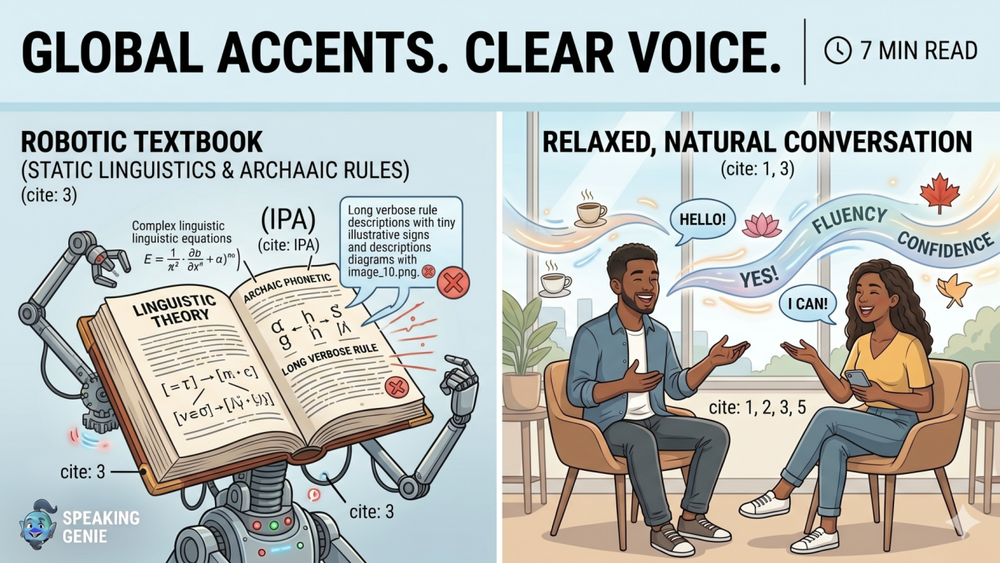
They understand you perfectly, but something feels off. You sound too formal. Too stiff. You sound like a walking grammar textbook. If your goal is to connect with people, sounding "perfect" is actually a barrier. Here is why you sound robotic, and how to transition from academic English to natural, conversational fluency.
The Textbook Trap
Traditional language schools are designed to pass written exams. They teach you to say: "Hello, how are you today? I am fine, thank you. I would like to purchase a coffee."
While this is 100% grammatically correct, a native speaker in a café would actually say: "Hey, how's it going? I'm good, thanks. Can I get a coffee?"
When you use academic English in a casual setting, it creates a subtle distance between you and the listener. It can make you feel like an outsider and, ironically, often triggers the speaking freeze because your brain is working too hard to construct formal, rigid sentences.
3 Ways to Speak English More Naturally
1. Master Contractions and Connected Speech
Native speakers are lazy. They rarely pronounce every single word clearly. Instead, they mash words together. This is called connected speech.
Instead of saying "Do you want to go out?", a native speaker says "D'ya wanna go out?" Instead of "I am going to," they say "I'm gonna."
You don't need to use heavy slang, but you must use basic contractions (I'm, can't, won't, haven't). If you say "I do not want to go," it sounds like you are angry or giving a dramatic speech.
2. Swap Formal Verbs for Phrasal Verbs
Textbooks love Latin-based, formal verbs. Native speakers love phrasal verbs.
- Instead of saying "I must depart," say "I need to take off."
- Instead of "Please continue," say "Please go on."
- Instead of "I cannot tolerate this," say "I can't put up with this."
Learning the top 50 most common phrasal verbs will do more for your conversational fluency than memorizing a dictionary of advanced academic vocabulary.
Ditch the Textbook
Learn how people actually talk. Practice casual, natural English conversations with Speaking Genie's interactive AI.
Start a Casual Chat Now3. Embrace Natural Fillers
Language learners are taught that saying "Uhm" is bad. While you shouldn't overuse it, native speakers use filler words constantly to buy time to think. The trick is using natural fillers instead of freezing in total silence.
Start using phrases like: "Well...", "You know...", "I mean...", "To be honest...". These short phrases signal to the listener that you are still thinking and haven't finished your turn to speak, giving you the time you need to stop translating in your head.
How to Unlearn "Robot" English
To start sounding natural, you need a safe place to practice making mistakes. If you try to use a new phrasal verb with a native speaker and use it incorrectly, it can be embarrassing.
This is where an AI conversational partner like Speaking Genie becomes your greatest tool. You can set the AI to "Casual Mode" and role-play everyday scenarios—like chatting with a neighbor, making small talk at a party, or asking a coworker about their weekend.
Because the AI uses natural, colloquial English, you will naturally start to shadow its rhythm and vocabulary. You build the neuro-confidence required to step away from the textbook and step into real life.
Speak English Like a Human, Not a Robot
Master connected speech, phrasal verbs, and natural conversational flow. Practice unscripted, real-world English with Speaking Genie today.
Try Speaking Genie for FreeInstant access. Learn the English they don't teach in textbooks.