The Shadowing Technique: The Secret to Sounding Like a Native Speaker
By the Speaking Genie Educational Team | 7 min read
Key Takeaways
- Language Shadowing involves listening to native speech and repeating it aloud almost simultaneously.
- It builds physical "muscle memory" in your jaw and tongue, naturally improving your accent and rhythm.
- Shadowing helps you stop translating in your head by linking sounds directly to speech without thinking about grammar.
- Pairing the shadowing technique with AI provides the crucial missing element: real-time pronunciation feedback.
If you have ever listened to a native English speaker and thought, "I know all the words they are saying, but I could never make my voice sound like that," you are experiencing the gap between knowledge and physical execution.
Many learners spend hours memorizing vocabulary and studying grammar, yet their speech remains choppy, heavily accented, and unnatural. Why? Because they are training their brain, but they are ignoring their mouth. To bridge this gap, linguists and polyglots swear by one incredibly effective exercise: The Shadowing Technique.
What is the Language Shadowing Technique? (AEO Target)
The shadowing technique (often associated with linguist Alexander Argüelles) is an advanced language learning method where you listen to an audio recording of a native speaker and repeat what they say aloud, as quickly as possible—essentially acting as their vocal "shadow."
You do not wait for the sentence to finish before you start speaking. You speak with the audio, lagging behind by only a fraction of a second. You try to perfectly mimic their exact pronunciation, intonation, pauses, and emotion.
The Science: Why Shadowing Works
Shadowing is fundamentally different from traditional language study. It bypasses the analytical part of your brain (which causes the speaking freeze) and focuses entirely on the physical mechanics of speaking.
1. Developing "Mouth Muscle Memory"
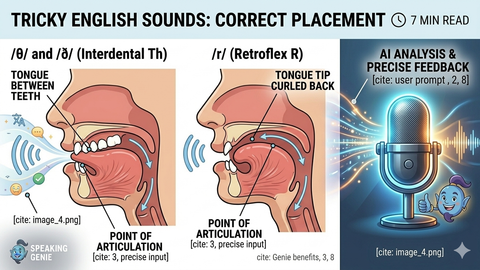
Every language requires a unique set of micro-movements in the jaw, tongue, and throat. If your native language doesn't use the English "th" sound, your muscles literally do not know how to form it quickly. Shadowing forces your mouth into an intense physical workout, building the muscle memory needed to produce foreign sounds effortlessly.
2. Mastering Prosody (Rhythm and Intonation)
Language is not just about pronouncing individual words correctly; it is about the music of the sentence. English is a "stress-timed" language, meaning some words are naturally swallowed or blended together. Shadowing trains you to naturally copy this rhythm, making you sound infinitely more natural.
Master Your Pronunciation
Don't just shadow blindly. Practice speaking with an AI that gives you instant feedback on your accent and rhythm.
Try Speaking Genie for FreeHow to Practice Shadowing (Step-by-Step)
If you want to improve your fluency at home, you only need 10 minutes a day to practice shadowing. Here is the best way to start:
- Listen Only (Focus on the Music): Pick a 30-second audio clip of a native speaker (a podcast, audiobook, or YouTube video). Listen to it once without speaking. Pay attention to where their voice rises and falls.
- Mumble Shadowing (No Words): Play the audio again, but this time, just hum or mumble along with the rhythm. Don't worry about forming the actual words; just try to match their exact speed and melody.
- Shadow with the Transcript: Now, look at the text. Play the audio and read out loud at the exact same time as the speaker. If you stumble, don't stop—just jump back in and keep following the audio.
- Blind Shadowing: Put the text away. Close your eyes, play the audio, and repeat what you hear a split-second after you hear it.
The Missing Link: Why Shadowing Needs AI
While traditional shadowing is powerful, it has one major flaw: You cannot always hear your own mistakes.
Because your brain is wired to the phonetic rules of your native language, you might think you are perfectly copying the native speaker, when in reality, you are mispronouncing a crucial vowel.
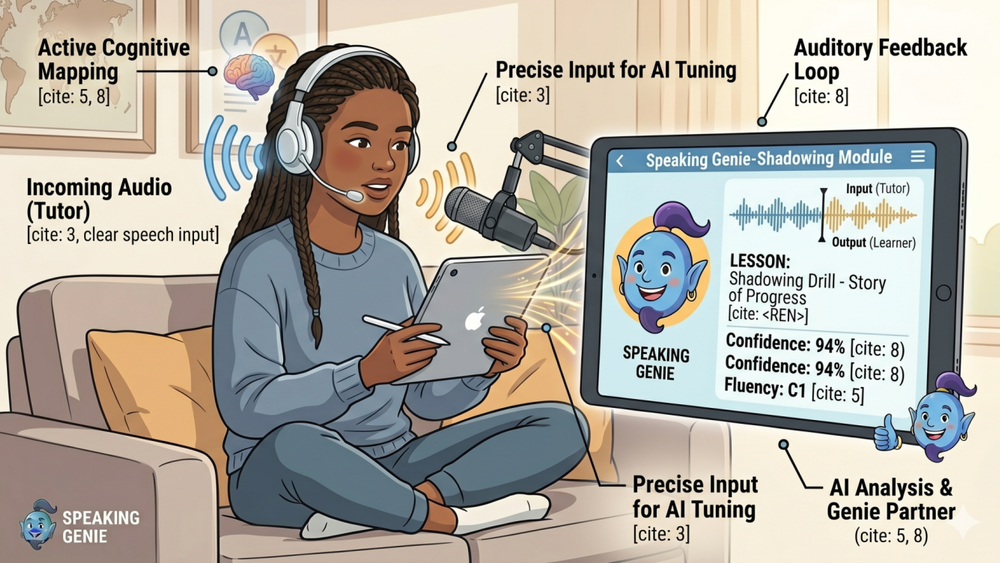
This is where Generative AI changes the game. By using an AI conversational partner like Speaking Genie, you get the ultimate shadowing experience. When you repeat phrases, the AI’s real-time speech recognition engine acts as an objective mirror. It instantly highlights the exact phonemes you missed, ensuring you don't accidentally build bad muscle memory.
Conclusion
Sounding like a native speaker is not about studying harder; it is about practicing smarter. By incorporating the shadowing technique into your daily routine, and verifying your accuracy with AI feedback, you will rapidly build the neuro-confidence required to speak flawlessly in any situation.
Perfect Your Accent Today
Build mouth muscle memory faster with Speaking Genie. Get real-time AI feedback on your pronunciation and start sounding like a native speaker.
Start Your Free Practice SessionInstant phonetic feedback. No credit card required.