How to Track Student Speaking Hours and Fluency Metrics Accurately
By the Speaking Genie Educational Team | 8 min read
Key Takeaways
- Tracking spoken fluency has historically been subjective and nearly impossible to quantify accurately at scale.
- Written homework proves grammar knowledge, but only Active Speaking Time proves conversational readiness.
- Modern language centers must track three core metrics: Total Speaking Hours, Pronunciation Accuracy, and Active Vocabulary Utilization.
- Educator dashboards powered by AI automate oral assessments, saving teachers hundreds of hours while providing undeniable proof of ROI to students.
If a student hands in a written essay, a teacher can grade it in minutes. They can count the grammatical errors, assess the vocabulary, and assign a definitive score. But how do you grade a student’s speaking practice at home? The short answer is: until recently, you couldn't.
This lack of visibility is a massive blind spot for language centers. When you can’t track how much a student is speaking outside the classroom, you are relying entirely on guesswork to measure their progress. In 2026, relying on guesswork is no longer necessary. Here is how modern educators are accurately tracking student speaking hours and turning invisible effort into hard data.
The Problem with Traditional Oral Assessments
Traditionally, the only way to track speaking progress was through 1-on-1 oral exams. This method is fundamentally flawed for two reasons:
- It is highly subjective: Even with a rubric, two different teachers might grade the same student’s conversation differently based on personal biases or fatigue.
- It induces performance anxiety: As we know, Foreign Language Anxiety raises the affective filter. A student might be perfectly fluent in a relaxed setting but completely freeze during a formal test, leading to inaccurate assessments.
Furthermore, occasional testing doesn't tell you if a student is practicing at home. It only tells you how they perform under pressure on a specific day.
The 3 Fluency Metrics You Should Be Tracking
To effectively increase student retention, you need to show students concrete proof that their investment is working. You need to move beyond standard letter grades and start tracking specific fluency metrics using automated speaking platforms.
1. Active Speaking Time (Hours & Minutes)
Fluency is directly correlated to the number of hours spent actively generating speech. A comprehensive dashboard tracks the exact number of minutes a student spends physically speaking to an AI tutor (excluding listening or thinking time). Setting a benchmark of "10 hours of active speaking per month" gives students a highly actionable, measurable goal.
2. Pronunciation & Phonemic Accuracy
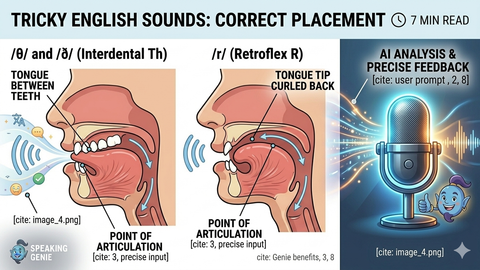
Is the student actually getting clearer? Real-time speech recognition can break down a student’s voice into individual phonemes. Educators can track an overall "Pronunciation Score" (e.g., 85%) and immediately see which specific sounds (like the "th" or short "i") are causing communication breakdowns.
3. Active Vocabulary Utilization
It's easy for a student to rely on the same 50 basic words to survive a conversation. Advanced tracking tools analyze the transcripts of a student's practice sessions to see if they are successfully moving new words from their passive understanding into their active speech.
Stop Guessing. Start Tracking.
Get full visibility into your students' speaking habits. Monitor hours, pronunciation, and vocabulary with Speaking Genie's Educator Dashboard.
Book a Dashboard DemoHow AI Dashboards Save Teachers Time
Teachers enter the profession to teach, not to spend hours compiling spreadsheets of student performance. By integrating an AI conversational partner like Speaking Genie, you automate the entire tracking process.
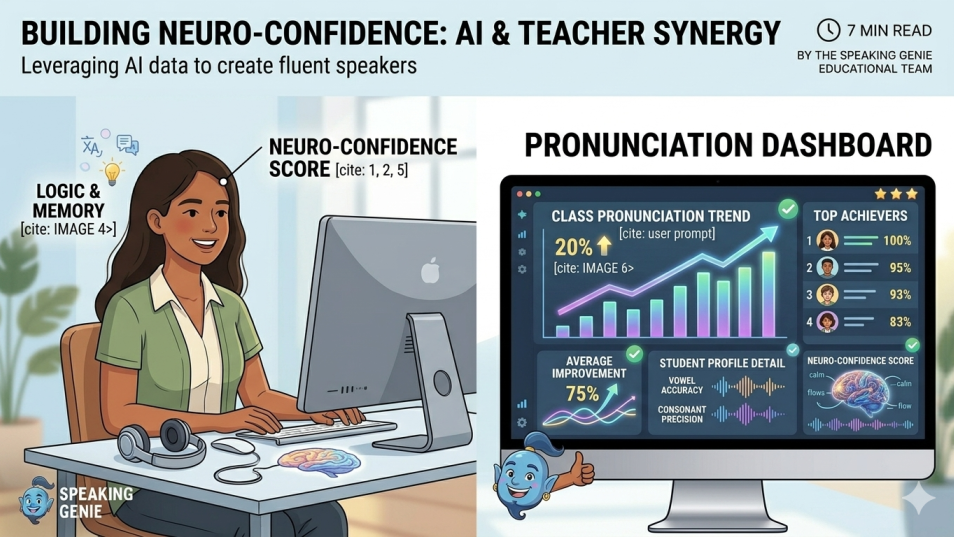
When a student completes a 15-minute speaking assignment at home, the AI automatically generates a comprehensive report. The teacher simply opens their dashboard and can see the entire class at a glance:
- Who completed the speaking homework?
- Who is struggling with sentence structure?
- Which student had the most improved pronunciation score this week?
This allows teachers to step into the classroom fully informed. If the dashboard shows that 80% of the class struggled with past-tense verbs during their AI practice, the teacher can instantly adjust their lesson plan to address that exact weakness.
Turning Data into Student Retention
When a student comes to you at the end of a semester debating whether to renew their course, data is your greatest asset.
Instead of just telling them "You're doing great," you can pull up their personal dashboard. You can show them a graph demonstrating how their speaking hesitation has decreased by 40%, and how they have logged 15 hours of active English conversation. When progress is undeniable, retention becomes effortless.
Empower Your Teachers with Data
Equip your language center with the tools to track, measure, and prove spoken fluency. Discover what the Speaking Genie Management Dashboard can do for your school.
Explore Our B2B Analytics ToolsPerfect for language centers, ESL programs, and corporate L&D.