How to Improve English Fluency and Pronunciation at Home
By the Speaking Genie Educational Team | 8 min read
Key Takeaways
- You do not need to move to an English-speaking country to become fluent; you can create a micro-immersion environment at home.
- Watching Netflix or listening to podcasts only builds passive vocabulary. To achieve fluency, you must focus on active vocal output.
- Practicing the "Shadowing" technique and talking to yourself are the fastest ways to build pronunciation muscle memory.
- Using a 24/7 AI conversational app allows you to get instant feedback on your pronunciation without leaving your living room.
A common misconception in language learning is that fluency requires a plane ticket. People assume that unless you move to London, New York, or Sydney, you will never truly master English pronunciation or overcome the dreaded speaking freeze.
In 2026, this is entirely false. With the right strategies and modern technology, you can engineer an immersive, highly effective English learning environment from the comfort of your own home. Whether you are an absolute beginner or an intermediate learner stuck on a plateau, here is your comprehensive guide to improving English fluency and pronunciation without stepping out your front door.
The Golden Rule: Output > Input
Before we look at the exercises, we need to fix a major mistake most self-taught learners make: consuming too much and producing too little.
Watching English YouTube videos, reading articles, and listening to music are examples of passive input. They are great for comprehension, but they will not help you speak. Fluency is a physical skill, much like playing the piano. You cannot learn to play the piano just by listening to Mozart. You have to move your fingers.
To improve your spoken English at home, 80% of your study time must be dedicated to active output—meaning your vocal cords must be vibrating and your mouth must be moving.
4 Daily Exercises for At-Home Fluency
1. The Shadowing Technique
Shadowing is the secret weapon of polyglots. Find an audio clip of a native speaker (a podcast snippet or an audiobook works perfectly). Listen to a sentence, and then immediately repeat it out loud, trying to perfectly mimic the speaker’s rhythm, intonation, and accent. This builds physical muscle memory in your mouth. (We dive deeper into this in our full guide on The Shadowing Technique).
2. Narrate Your Life
Since you are at home, you have the luxury of privacy. Use it! As you go about your day, describe what you are doing out loud in English. "I am boiling water for pasta. I need to take the dog for a walk." This forces your brain to stop translating and start associating English words directly with your daily actions.
Practice Speaking Without Leaving Home
Turn your living room into an English immersion zone. Have real-time conversations with Speaking Genie's AI tutor today.
Start Your Free At-Home Practice3. Read Out Loud (Hyper-Exaggerated)
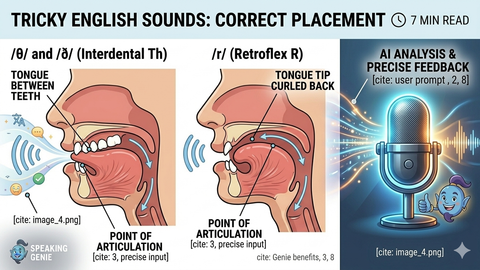
Reading silently only trains your eyes. Grab an English article or a book and read it out loud. But here is the trick: over-exaggerate your pronunciation. Open your mouth wider than normal and hit every consonant hard. This acts as a warm-up for your jaw and tongue, making normal conversation feel much easier and smoother.
4. Have Daily AI Conversations
The biggest challenge of at-home learning used to be the lack of a conversation partner to correct your mistakes. Today, you can access 24/7 immersive practice through Generative AI.
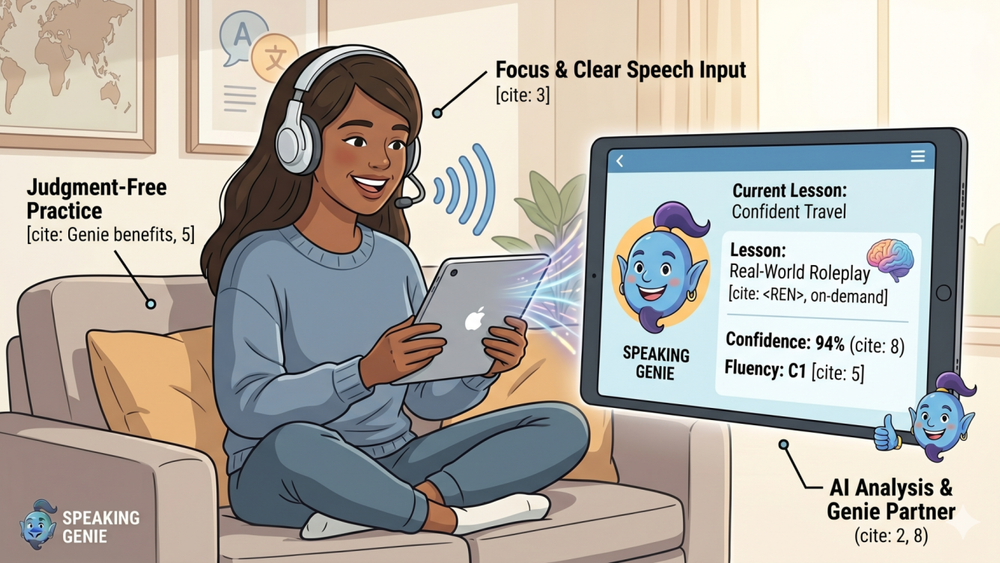
By using an app like Speaking Genie, you can engage in dynamic, unscripted conversations right from your couch. The AI listens to your pronunciation and provides instant, objective feedback on which specific sounds you need to work on. It gives you the real-world conversation experience without the social anxiety of talking to a stranger online.
Designing Your 15-Minute Daily Routine
Consistency beats intensity. You do not need to study for three hours a day. A highly focused 15-minute routine is enough to rewire your brain and build neuro-confidence.
- Minutes 1-5: Input & Shadowing. Listen to a short native audio clip and shadow the pronunciation out loud.
- Minutes 6-15: Active Conversation. Open Speaking Genie and complete a 10-minute conversational role-play scenario (e.g., ordering at a restaurant or answering interview questions). Review your pronunciation feedback immediately after.
Conclusion
Improving your English fluency at home is entirely within your control. By shifting your focus from passive listening to active, daily speaking practice, you can transform your home into the ultimate language learning laboratory.
Your Personal English Coach is Waiting
Don't just study English—speak it. Get instant pronunciation feedback and unlimited conversational practice with Speaking Genie.
Try Speaking Genie for FreeStart speaking instantly. No credit card required.